The February 2021 Freeze and the Plants That Returned
What the 2021 winter storm did to South Texas yards, which plants died and which resprouted, and how Laredo homeowners rebuilt their planting lists after it.
Service
A yard built to look deliberate on a fraction of the water, using plants that were growing on this ground long before anybody irrigated it.
Xeriscape has an image problem in South Texas, largely because a lot of what gets called xeriscape is a gravel rectangle with three agaves in it. Done properly it is the opposite of bare: it is a planted landscape where the species selection, the soil preparation, and the irrigation design are matched to a place that averages 19.68 inches of rain a year and takes it in unreliable bursts. The plant palette is genuinely large. Cenizo, which the Texas Legislature designated the State Native Shrub in 2005 under the name Texas Purple Sage, flowers after humidity spikes and needs no summer irrigation once established. Esperanza, lantana, blackfoot daisy, damianita, and salvias carry color from spring to first frost. Anacahuita and Texas ebony give small-tree structure. Sotol, agave, and yucca provide the architectural forms. Native grasses do the work turf cannot: the USDA soil survey records buffalograss, tanglehead, and trichloris as climax vegetation on the Webb series, meaning those grasses were the natural cover on this exact ground. A xeriscape conversion also changes the maintenance profile rather than eliminating it, and any honest description of the work says so.
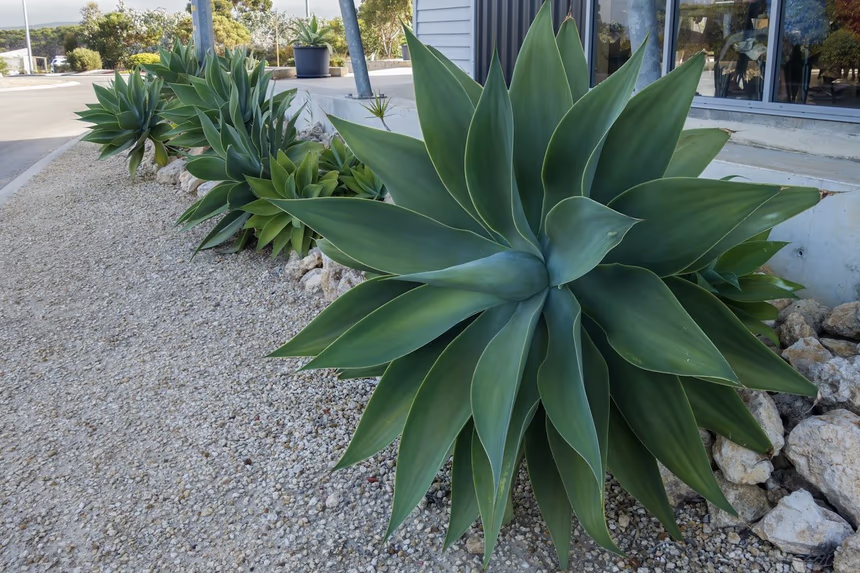
That is one version of it, and it is the version that gives the approach a bad name. A xeriscape in the proper sense is a planted landscape designed so that most of it survives on rainfall once established. The palette available on the Rio Grande Plain runs to dozens of flowering shrubs, perennials, small trees and grasses, and a well-built example is denser and greener through the year than the turf-and-shrub yard it replaced. Gravel appears in it as paths and negative space, not as the main event.
The honest answer is that it depends almost entirely on how much turf comes out, because turf is where the water goes. Replacing a large irrigated lawn with beds on drip is a substantial reduction; replacing shrub beds that were already on drip changes very little. The other difference people notice is in a bad summer: beds on drip hold their appearance on a fraction of the water, while a sprinkler-fed lawn is the first thing to go brown the moment watering has to be cut back.
Yes, for the first year or two, and this is the single most common reason conversions fail. A cenizo out of a small nursery pot in November has a root ball the size of a grapefruit and no way to reach water beyond it. It needs regular irrigation through its first two summers while roots extend into the surrounding soil. After that, most of the standard palette here holds without supplemental water in a normal year and wants an occasional deep soak in a bad one. A schedule with dates on it is worth asking for.
Less than a turf lawn does, which is the useful comparison. Bermudagrass goes dormant and brown for several months; cenizo, agave, sotol, yucca, Texas sage varieties and most of the native shrubs hold their foliage year round. Perennials like lantana and esperanza die back and return. A design that mixes evergreen structure with the deciduous color plants gives the yard something to look at in January, which a monoculture lawn does not.
A great deal of damage, and it is worth knowing about before choosing plants. The February 2021 winter storm pushed hard freezing temperatures far further south than the usual design assumption, and tropical and subtropical ornamentals across South Texas were killed outright while established natives largely came back from the roots. That event is a reasonable argument for building the permanent structure of a yard from species that have survived cold snaps on this ground historically, and treating tender tropicals as replaceable color rather than as the backbone.
Different maintenance, and generally less of it, but not none. Mowing largely disappears, which is the biggest labor saving. In its place come one or two hard prunings a year on the flowering shrubs, mulch topping up as it breaks down or blows, weeding in the gravel areas until the plants close in, and drip emitter checks, since emitters clog and a clogged emitter is invisible until the plant dies.
Related Reading
What the 2021 winter storm did to South Texas yards, which plants died and which resprouted, and how Laredo homeowners rebuilt their planting lists after it.
Why the cool season carries the productive landscape work in Laredo, a month-by-month schedule from October to March, and why summer pruning backfires.
Why cenizo anchors so many Webb County yards, what triggers its flowering, and which companion plants turn a thin-looking xeriscape into a composed border.
Other Work
Landscape work here comes in a natural order, because on this ground you cannot reverse the sequence later. Grading and drainage first, then irrigation mainlines and sleeving under anything that will be paved, then hardscape, then soil preparation and planting. Anything installed out of order gets dug up by the next trade, so it is worth pricing the whole sequence even when the build is phased.
A plan for the whole lot, drawn around the sun angles, the caliche depth, and how much of the ground is going to be irrigated at all
Sprinkler and drip installation, zone splitting, controller programming and leak repair, designed for a climate that takes back most of what a spray head throws
Patios, walkways, seating walls and shade structures, built for a climate where usable outdoor space means shaded outdoor space
New lawns, patchy lawn replacement and turf reduction, with a grass choice made for a long hot summer and the water the lawn will realistically get
Ring (956) 477-4933, or send the quote form. Quotes are free and the price belongs to the contractor.