How You Water, and Everything It Quietly Decides
Why spray and drip are not the same act in this climate, how to set a controller that nobody revisits, and what that one difference does to the layout of a Laredo yard.
Service
Sprinkler and drip installation, zone splitting, controller programming and leak repair, designed for a climate that takes back most of what a spray head throws.
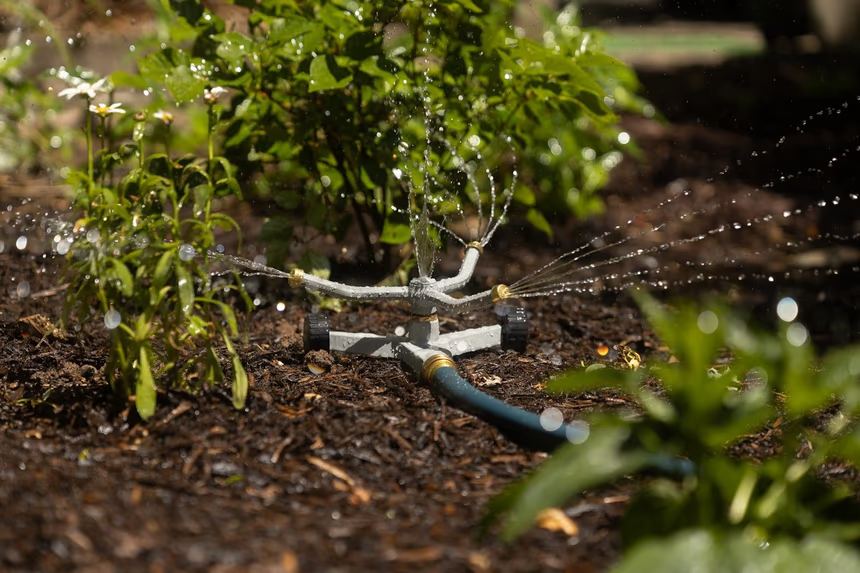
Irrigating in a hot semi-arid climate is a different design problem from irrigating almost anywhere else, because the losses are so much larger. Water thrown through the air on a July afternoon in this city, where the daily high averages 100.3F and most lots are open to the wind, gives up a serious share of its output to evaporation and drift before it ever reaches root depth. Drip does not work that way: it meters water onto the soil at the root zone at a rate the ground can absorb. So a system built for Laredo looks different from a generic one. Fewer, better-scheduled spray zones covering only the lawn people walk on, and everything else on drip. The most common retrofit here is splitting a legacy zone that waters lawn and beds together, because those two want opposite schedules: run it long enough for the grass and the shrubs sit wet, run it short enough for the shrubs and the grass browns. The other thing worth getting right at installation is backflow prevention on the potable connection, which is what keeps irrigation water out of the drinking supply.
Longer than most controllers are set for, and less often. Deep, infrequent watering pushes roots down; short daily cycles hold them up near the surface, in exactly the layer that dries out first and fails first in a hot spell. The limit is how fast the ground will take water. Sandy loam over a cemented carbonate layer absorbs only so quickly, and one long soak on a compacted lawn ends up running down the driveway. Cycle-and-soak, which splits a zone into two or three shorter runs with a gap between them, delivers the same volume with far less loss and needs no hardware at all.
Early morning, finishing before the sun is properly on the yard. A spray zone running at two in the afternoon in July, when the daily high averages 100.3F and the wind is moving across an open lot, loses a large share of its output before the water reaches root depth. Late evening is the next best window: less goes into the air, but foliage stays wet overnight, which suits some plantings less than others. Drip is far less sensitive to the hour, which is one more reason beds end up on it.
Two reasons, and the first one is most of it. Spray in a shrub bed loses a large share of its output to evaporation and wind in a climate this hot and this exposed, while drip puts water on the soil at the root zone at a rate the ground can absorb. Second, spray wets foliage and hard surfaces and encourages weeds in the gaps between plants, and drip does not. A bed on drip also runs on its own schedule rather than borrowing the lawn's, which is usually wrong for it in both directions.
Underground irrigation leaks usually announce themselves on the bill long before they show at the surface, particularly on well-drained sandy loam that swallows the water. The standard diagnostic is to shut the irrigation isolation valve and watch the meter: if the meter still turns with all household fixtures off, the leak is on the house side; if it stops, it is in the irrigation. From there it is a matter of running each zone and watching pressure and coverage. A stuck valve diaphragm is the other common cause and looks identical on a bill.
It is a small cost against a real benefit in a place with rainfall this uneven. Laredo averages 19.68 inches of rain a year, and a meaningful part of that can arrive in a handful of storms, so a controller running its normal program the morning after 2 inches of rain is pure waste. A rain sensor or a soil moisture sensor interrupts that automatically. Most modern controllers accept one, and adding it to an existing system is usually straightforward.
It can, but it costs more and the result is usually worse, because trenching through established beds means damaging roots and disturbing plants that have just settled. Where a landscape is being built in phases, the standard approach is to install mainlines and sleeving in the first phase even if the zones themselves come later, since the expensive and disruptive part is the trenching and the crossings under hard surfaces.
Related Reading
Why spray and drip are not the same act in this climate, how to set a controller that nobody revisits, and what that one difference does to the layout of a Laredo yard.
Thin topsoil, wall-to-wall turf and one overworked irrigation zone: what a new-build Laredo yard lacks, what each repair costs, and which order to spend in.
Other Work
Landscape work here comes in a natural order, because on this ground you cannot reverse the sequence later. Grading and drainage first, then irrigation mainlines and sleeving under anything that will be paved, then hardscape, then soil preparation and planting. Anything installed out of order gets dug up by the next trade, so it is worth pricing the whole sequence even when the build is phased.
A plan for the whole lot, drawn around the sun angles, the caliche depth, and how much of the ground is going to be irrigated at all
A yard built to look deliberate on a fraction of the water, using plants that were growing on this ground long before anybody irrigated it
Patios, walkways, seating walls and shade structures, built for a climate where usable outdoor space means shaded outdoor space
New lawns, patchy lawn replacement and turf reduction, with a grass choice made for a long hot summer and the water the lawn will realistically get
Ring (956) 477-4933, or send the quote form. Quotes are free and the price belongs to the contractor.